
Key points:
- ABA techniques teach specific social skills, like initiating and turn-taking, and help generalize them to real school settings.
- Peer mediated interventions, video modeling, and Pivotal Response Training are evidence-based ABA approaches that improve classroom social interactions.
- Small, consistent steps at home and school, plus coordinated plans with teachers, make friendships more likely and more sustainable.
Social connections can be one of the hardest areas for children with autism, but also one of the most rewarding. Many parents watch their child struggle to join playgroups, start conversations, or maintain friendships, unsure how to help. ABA therapy focuses on breaking down social skills into manageable, teachable steps, like turn-taking, perspective-taking, and reading nonverbal cues.
With structured guidance and practice, children can develop confidence in social settings and form genuine connections. This article explores how ABA principles can support friendship-building in school environments and beyond, helping children engage more comfortably and meaningfully with peers.
Why making friends is hard for some children with ASD
Children on the autism spectrum often find aspects of social interaction, reading nonverbal cues, starting a conversation, or fast-paced group play, confusing or overwhelming. These differences are common features of ASD and can show up across development. Understanding that social skill challenges are learning differences, not a lack of desire for connection, helps you choose calm, skill-focused supports.
How ABA helps, in plain language
Applied behavior analysis, ABA, breaks complex social behavior into small teachable steps. Instead of saying “be social,” ABA identifies the exact behaviors to teach, such as:
- making eye contact for one second,
- offering a toy,
- asking a classmate, “Can I play?”
Practices are repeated, reinforced, and gradually combined, so skills generalize from therapy sessions to the real world. ABA also trains peers and caregivers so learning happens where children actually spend their day. Evidence shows ABA-based peer-mediated interventions and naturalistic approaches can increase real peer interactions.
Practical, evidence-backed ABA strategies to teach friendship skills

1. Teach small building blocks first
Break social tasks into tiny, observable steps. For example, teach “joining a game” as a sequence:
- Stand near the group for 5 seconds,
- Watch for a pause in play,
- Offer a simple comment or action,
- Accept a “yes” or “no” response.
Use modeling and role play at home, then practice at school during closely supervised times.
2. Use prompting and fading
When a child needs help starting, provide a prompt they can follow, such as a sentence starter: “Want to play?” Gradually fade prompts to encourage independent initiations. Reinforce any attempt, even partial, because praise for small attempts builds confidence and increases attempts over time.
3. Video modeling to show what to do
Video modeling uses short clips to demonstrate a social behavior, then the child watches and practices. Studies going back many years show video modeling increases social initiations and play skills for children with ASD. Make short, clear clips of peers or adults demonstrating the exact social behavior you want your child to copy.
4. Peer mediated interventions, teach peers to help
Train a few receptive classmates to prompt, model, and reinforce social behavior. Peer-mediated approaches consistently improve real play and conversation opportunities because they create natural chances for connection during the school day. Schools can implement this by selecting friendly, empathetic peers and giving them small scripts and reinforcement ideas.
5. Pivotal Response Training, focus on motivation and initiation
Pivotal Response Training, an ABA-based naturalistic method, targets pivotal skills like motivation and initiation so gains generalize across settings. PRT uses child-preferred activities, reinforcing attempts and building on natural consequences, which often leads to broader improvements in social communication. Parent training in PRT can support carryover to classroom and recess.
6. Use social scripts and role-play
Create short scripts for common school moments, for example, “Hi, want to use my crayons?” Practice them with puppets, toys, or during car rides. Scripts lower cognitive load and give a predictable pathway to connection.
7. Reinforce friendships, not just behaviors
Reinforcers should include social rewards when appropriate, such as shared play time, positive notes from peers, or structured small-group activities. When a child receives both social and tangible reinforcement, the social behavior becomes more naturally rewarding.
Concrete steps parents can use this week
- Observe one social moment at school, then write a 3-step plan to support it.
- Make a 30-second video model of the desired interaction and watch it with your child twice daily for a week.
- Ask the teacher to approve a peer buddy for 10 minutes a day during recess or group work. Provide the teacher with a short script peers can use.
- Reinforce attempts at home, even if the outcome at school is mixed. Small wins compound.
Partnering with the school: what to ask and how to collaborate
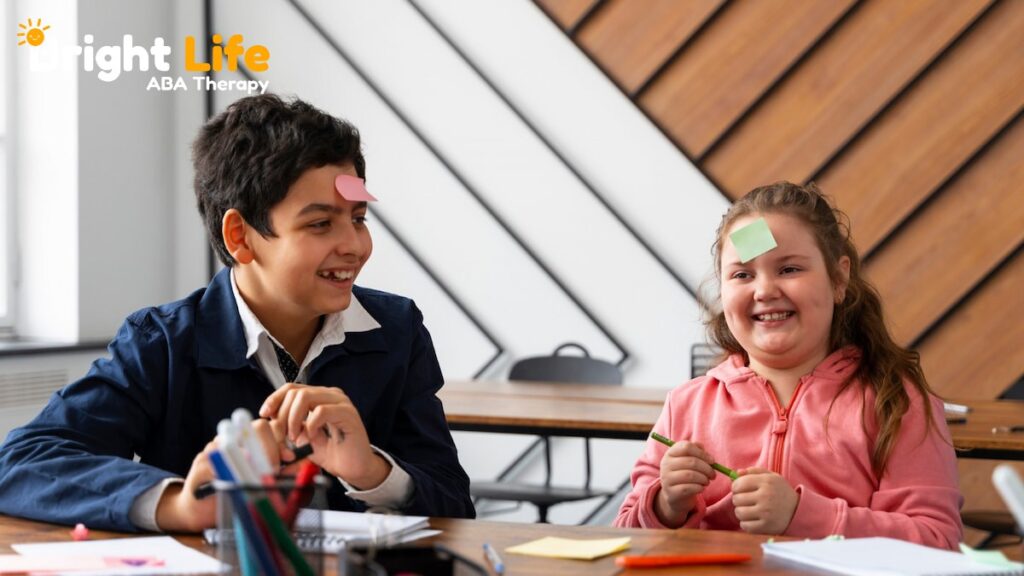
A collaborative plan between family, ABA providers, and teachers makes success more likely. When you meet with the school, consider asking for:
- a short, written social goal and how it will be measured,
- permission for short in-class practice sessions,
- a small group or peer-mediated plan during recess,
- consistent reinforcement strategies between home and school.
If the school offers in-school ABA supports, request clear examples of how sessions will generalize to peer contexts, and ask for regular progress updates.
How teachers can implement ABA-informed supports (brief guide)
- Offer predictable routines and visual support like social scripts and play cards.
- Teach one social skill at a time and prompt with fading plans.
- Use peer-mediated strategies by training cooperative classmates with simple scripts and reinforcement tokens.
- Coordinate brief coaching with the child’s ABA therapist to align language and reinforcement.
Evidence shows teacher- and parent-delivered ABA strategies can extend benefits across settings.
When to bring in extra support
If friendships remain rare after consistent practice and school collaboration, consider these signs that you might need more intensive or targeted support:
- refusal to enter social situations beyond occasional anxiety,
- no increase in attempts after several weeks of consistent practice,
- safety concerns like frequent conflicts or bullying.
More targeted ABA programs, social skills groups, or additional school-based supports can be explored, and they often improve outcomes when added to existing practice.
Measuring progress in a meaningful way
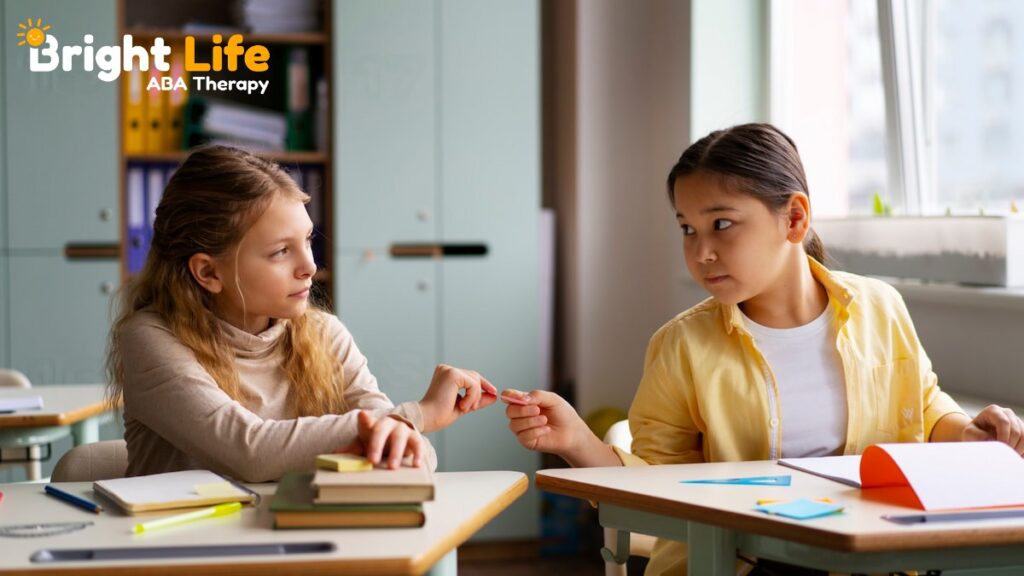
Focus on observable measures rather than vague impressions. Examples:
- number of spontaneous social initiations per recess,
- time spent engaged with peers,
- successful turn-taking events in structured play.
Track progress for short periods (two weeks) and celebrate small improvements. Objective measurement reduces anxiety for parents and helps tailor next steps.
Realistic expectations and emotional support
Friendship skills develop gradually. Some children build one or two steady friendships, others expand their social network slowly. Celebrate small signs of connection, like a shared joke or repeated play invitation. Keep conversations positive and concrete, for example, “You asked to join, that was brave, let’s try again next time.”
Open New Doors: Use ABA To Support Friendship and Confidence
Every parent wants to see their child included, happy, and confident around peers. Through structured ABA techniques, Bright Life ABA helps children with autism learn vital social skills, like initiating play, reading emotions, and maintaining conversations, while reinforcing natural opportunities for connection.
Our therapists create supportive environments that mirror real-life social settings, helping children practice friendships that last beyond the classroom. Parents also receive actionable tools to encourage social growth at home and in the community.
If you’re in Indiana or Maryland, reach out to Bright Life ABA today to discover how ABA therapy can empower your child to connect, communicate, and flourish among friends.